

SPARK: Unlocking Rural Road Safety and Resilience towards EU Vision Zero
HORIZON-CL5-2026-10-D6-09
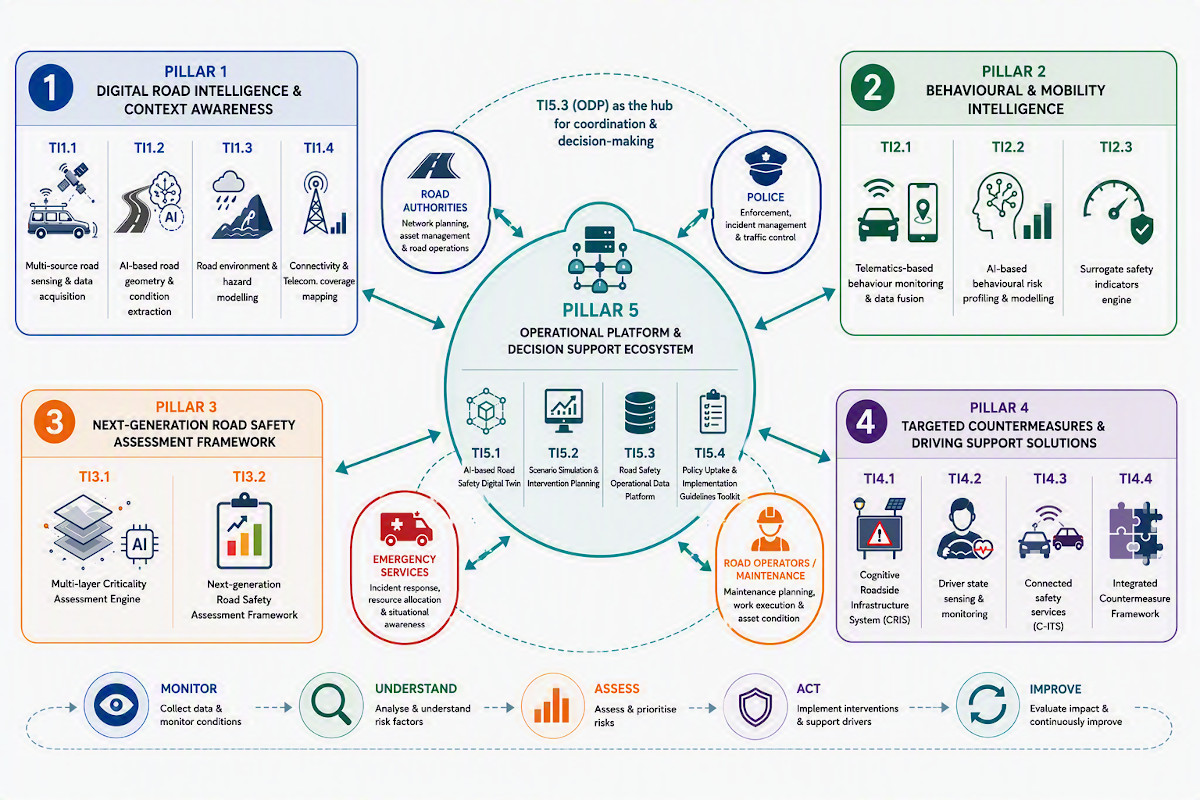
The main objective of SPARK is to support local and regional authorities in reducing fatalities and serious injuries on rural roads while strengthening the resilience of rural transport networks to climate-related and emerging risks. To achieve this, SPARK will transform current road safety assessment practices into a continuous, data-driven and intelligence-led process by:
a. generating comprehensive digital intelligence on road infrastructure and operating conditions
b. leveraging behavioural and vehicle-derived data to better understand crash causation and risk factors
c. enhance the accuracy and predictive capability of Network-Wide Road Safety Assessment (NWRSA)
d. identifying and prioritising the most effective safety interven-tions
e. improving the understanding and management of climate and natural-hazard impacts on rural roads
f. enabling continuous operational safety and resilience management by road authorities.
These objectives will be achieved through six complementary innovation pillars and their associated Technology Inno-vations (TIs):
1. Digital Road Intelligence for large-scale characterisation of rural road networks, including resilience intelligence for climate and natural-hazard risk assessment and monitoring.
2. Behavioural Intelligence for understanding driving patterns, crash causation and risks.
3. Next-Generation NWRSA integrating infrastructure, behavioural and resilience intelligence.
4. Targeted Safety Interventions supporting evidence-based prioritisation of countermeasures.
5. Operational Safety Management enabling continuous, network-wide safety and resilience manage-ment.
MEMBERS
Centro de Estudios de Materiales y control de Obras S.A. (CEMOSA)
Rubiq Symvouloi Michankoi L.P
Universidade de Vigo
National Technical University Of Athens
Nira Dynamics AB
Research Driven Solutions Limited
Fundación Tecnalia Research and Innovation
AUSTRALO Alpha Lab MTU
Asociacion Centro Tecnologico CEIT
Kraj Vysočina (Vysocina Region)
Krajská správa a údržba silnic Vysočiny (Vysocina Road Maintenance A.)
VSIA Latvijas Valsts ceļi (Latvian State Roads)
The participation of Applied Geotechnologies Research Group has been partially supported by Universidade de Vigo (Axudas propias á investigación da Universidade de Vigo, convocatoria 2026).
LIFELINES: Living transport Infrastructure For Europe: Linking Innovation, Nature, and Economic Sustainability
HORIZON-CL5-2026-01-D6-07
Europe’s transport infrastructure underpins economic competitiveness, cohesion, and mobility, yet faces growing pressures from climate extremes, ageing assets, resource scarcity, and biodiversity loss. Roads, railways, and ports remain material- and emissionintensive, fragment ecosystems, and are often managed through reactive approaches that underuse data, lifecycle evidence, and nature-based solutions, leading to rising costs, service disruptions, and environmental impacts.
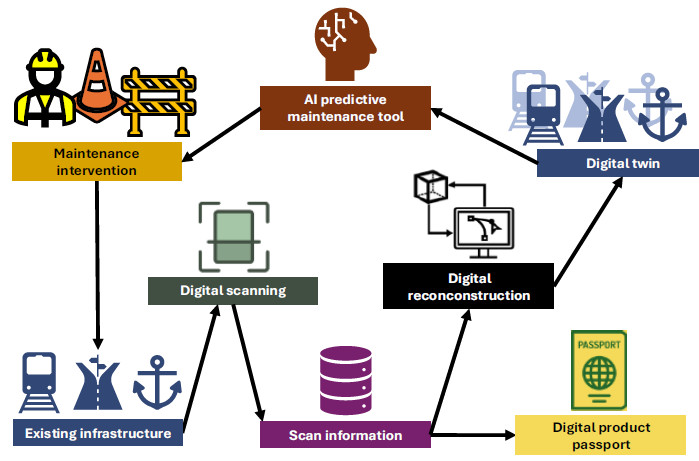
LIFELINES addresses these challenges by delivering an integrated, lifecycle-based approach to circular, climate-resilient, and naturepositive transport infrastructure. The project links corridor-level resource and asset data with validated innovative materials, embedded nature-based solutions, interoperable digital systems, and harmonized sustainability and resilience assessment methods. Through large-scale demonstrations across roads, railways, and ports in diverse TEN-T environments, LIFELINES advances solutions from TRL 5–6 to TRL 7+, validating performance under live traffic, operational constraints, and climate stress. The project combines high-share recycled and recovered materials, digital twins, AI-assisted monitoring, Digital Product Passports, and co-designed naturebased interventions to optimize whole-life emissions, resilience, circularity, and biodiversity outcomes. Integrated LCA, LCC, resilience modelling, and multi-criteria decision analysis provide decision-ready evidence for infrastructure owners and authorities.
LIFELINES translates pilot results into procurement guidance, standardization pathways, and governance models, enabling replication and market uptake across the European transport network. By connecting innovation, nature, and economic sustainability within real infrastructure corridors, LIFELINES supports Europe’s transition to resilient, low-emission, and nature-positive transport systems.
MEMBERS
1 UNIVERSITETET I AGDER
UNIVERSITA DEGLI STUDI DI PADOVA
OLYMPIA ODOS ANONYMI ETAIRIA PARACHORISIS GIA
ABO AKADEMI
ECOLOGIC INSTITUT GEMEINNUTZIGE GMBH
UNIVERSIDAD DE VIGO
AUTORIDAD PORTUARIA DE BILBAO
Oy Kaskisten Satama-Kaskö Hamn Ab
ELSAMEX GESTION DE INFRAESTRUCTURAS S.L.
NORSUS NORSK INSTITUTT FOR BAEREKRAFTSFORSKNING
RETE FERROVIARIA ITALIANA
Infrarail srl
ESTRAHUB LTD
ArcGeo
UNIVERSITY COLLEGE LONDON
BRUNEL UNIVERSITY LONDON
ETHNICON METSOVION POLYTECHNION
Serbian ITS Association
FERROVIE DELLO STATO ITALIANE SPA
The participation of Applied Geotechnologies Research Group has been partially supported by Universidade de Vigo (Axudas propias á investigación da Universidade de Vigo, convocatoria 2026).
RESTORE: Proposal title REsilient and Sustainable TranspORt infrastructure in European corridors
HORIZON-CL5-2026-01-D6-07
RESTORE is an Innovation Action that seeks to support resilience, sustainability, circularity and biodiversity across Europe’s TEN-T transport network. The TEN-T is essential for the freedom of movement and goods that underpins the European economy, and corridors represent the most strategically important part of the network. Much of the network is already in place, but further significant construction planned in the coming years; these activities must progress alongside the maintenance of existing infrastructure. This is all happening within a dynamic environment, as Europe strives to decarbonise construction processes and boost circularity, while also taking measures to address the biodiversity crisis and make our network more resilient when faced with disruptions. This must all happen in a way that is transparent and cost-effect and provide value for Europe’s citizens.
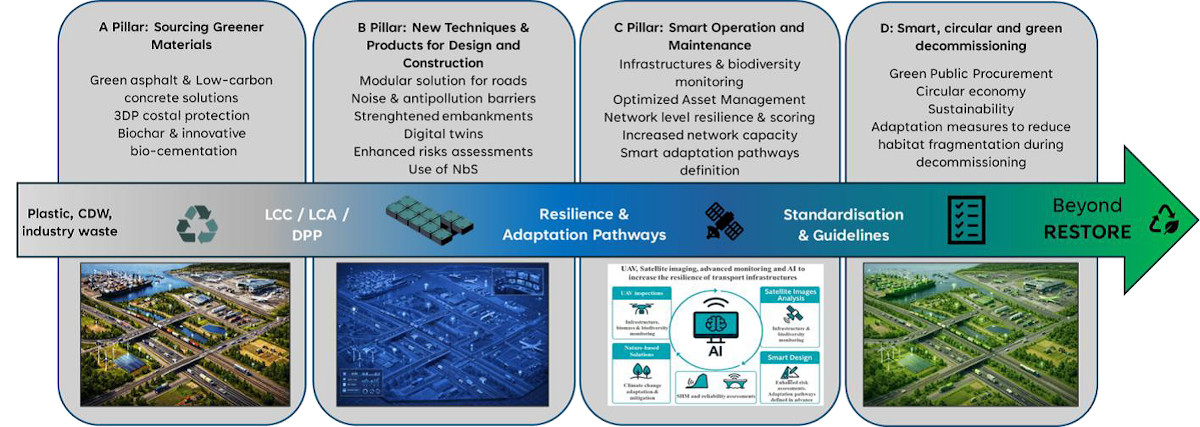
RESTORE will meet these challenges by shifting from traditional engineering practices to a new, holistic approach for managing transport corridors and nodes. RESTORE will leverage advances in digital technologies and apply this to 4 key principles. RESTORE will:
- Build resilience through adaptation
- Support the circular economy and reduce embodied carbon through the use of more sustainable construction materials
- Generate positive impacts to network users, ecosystems and biodiversity through the increased use of nature-based solutions
- Develop and validate solutions that are suitable for all transport modes
RESTORE will target environmental, technical, social, organisational and economic aspects, and apply innovations to pilot sites that cover all transport modes and all life cycle stages. This approach will be validated with the support of a strong multidisciplinary team covering the entire value chain. Clear measures of success are identified, and these will drive innovation in climate resilience and sustainable transport practices.
MEMBERS
UNIVERSITY COLLEGE DUBLIN
INFRA PLAN KONZALTNIG JDOO ZA USLUGE
ACCIONA CONSTRUCCION SA
INGENIERIA ESPECIALIZADA OBRA CIVIL E INDUSTRIAL SA
FORUM DES LABORATOIRES NATIONAUX EUROPEENS
LABORATORIO NACIONAL DE ENGENHARIA CIVIL
APDL - ADMINISTRACAO DOS PORTOS DODOURO E LEIXO
CENTRO DE ESTUDIOS Y EXPERIMENTACION DE OBRAS PUBLICAS
UNIVERSIDAD DE VIGO
INGEO BV
DIGITALTWIN TECHNOLOGY GMBH
ZAVOD ZA GRADBENISTVO SLOVENIJE
ASOCIACION ESPANOLA DE NORMALIZACION
BETON - LUCKO DOO ZA GRADITELJSTVOPROIZVODNJU
MEDUNARODNA ZRACNA LUKA ZAGREB DD
ECOCELTA GALICIA, S.L.
TERROIKO
Soletanche Bachy
SOCORPENA, CONSTRUÇÃO E OBRAS PÚBLICAS, LDA
AECOM Ireland Limited
HRVATSKE AUTOCESTE DRUSTVO S OGRANICENOM ODGO
EUROPEAN SCIENCE COMMUNICATION INSTITUTE (ESCI)
TRANSPORT INFRASTRUCTURE IRELAND
MINISTERIO DE TRANSPORTES Y MOVILIDAD SOSTENIBLE
IARNROD EIREANN
The participation of Applied Geotechnologies Research Group has been partially supported by Universidade de Vigo (Axudas propias á investigación da Universidade de Vigo, convocatoria 2026).

RADAR-EYE: Road monitoring using cutting-edge radar-based Technologies
Convocatoria: Consolidación Investigadora 2024
Financiación: Financiado por MICIU/AEI/10.13039/501100011033
Referencia: CNS2024-154766
SUMMARY
RADAR-EYE leads to develop an innovative solution for an automatic recognition of existing subsurface damages, to have an up-to-date overview of the real condition of road pavement structures, in combination with a decision-support system. The combination of radar techniques, Interferometric Synthetic Aperture Radar (InSAR) at network level and Ground-Penetrating Radar (GPR) at project level, is proposed. Thus, the InSAR can monitor thousands of kilometers of roads all at once, cheaply and without traffic interruptions, alerting about critical areas suffering of ground and structural movements (subsidence and potential sinkholes, displacements in transition zones, etc.). Then, punctual onsite GPR surveys can be conducted in the areas informed by InSAR, as it provides more ground penetration and detail in damage detection (voids or cavities, moist areas, layer thickness deficiencies, etc.).
Following the state-of-the-art, the general objective of RADAR-EYE aims to develop an innovative and competitive solution in order to provide an early warning of subsurface damage in road pavements based on InSAR and GPR data. New procedures and Artificial Intelligent algorithms will be developed for the automatic detection of damages. Nowadays, transport infrastructure (TI) digitization is gaining popularity for monitoring and maintenance strategies, as reliable and effective information exchange is crucial to any industry. Misinterpretations or delays directly translate into increased cost and time requirements. TI are long-lasting investments that shall be functional for many decades and must deal with different domains and large amount of data that needs a collaborative environment to work together. This requires a framework for semantic integration of data sources that must deal with different types of data exchange standards. A standardized pipeline will be therefore developed for interoperable data exchange and management using the OGC LandInfra (GML) standard. The usage of a standardized data format, which is not controlled by any specific software producer, may simplify the implementation of BIM-GIS and dynamic digital twin methodologies, which shall be independent of the software suites employed by the project agents. Finally, an Augmented Reality tool will be implemented to provide an easy and intuitive onsite visualization of all the data, highlighting the damages over the real world and functioning as a management platform on which onsite decisions can be made, thus supporting decision makers.
ROAD4SAFE: Proactive road safety risk prediction through multi-source AI and Big Data to enable datadriven decisions and interventions
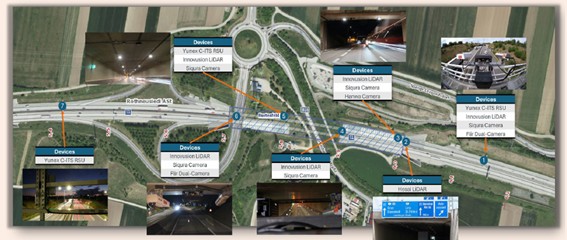
ROAD4SAFE aims to enhance road safety by predicting and preventing crashes before they occur, leveraging Artificial Intelligence (AI) and big data. The project will develop an AI-powered Digital Twin (DT) of road traffic and infrastructure, integrating data from multiple sources (connected vehicles, infrastructure sensors, environmental and historical data) to generate real-time risk predictions at local and network-level hazard maps. These predictions will feed into a Decision Support System (DSS) that prioritizes and triggers proactive safety measures, delivered to users via Human-Machine Interfaces (HMIs) and Cooperative Intelligent Transport Systems (CITS).
The project will focus on addressing data fragmentation and improving data quality by developing a federated, FAIR-compliant data architecture and AI models that ensure bias control, optimal sample size, and explainability. Additionally, ROAD4SAFE will tackle challenges in data acquisition and integration, providing solutions for low-latency, real-time data processing through cloud-edge hybrid systems. Two complementary pilots will be conducted: the Rustenfeld Living Lab (Austria), testing critical scenarios in tunnels and entrance-exit ramps, and the Bizkaia Connected Corridor (Spain), assessing network-scale risk prediction.
The project will develop and test predictive AI models for real-time hazard forecasting and implement these through a dynamic, multi-scale Decision Support System. By the end of the project, technologies will reach TRL 5-6, offering a comprehensive solution for proactive safety management, aligned with the EU's Vision Zero goal.
MEMBERS
1 UNIVERSIDAD DE VIGO Coordinator
2 LUNDS UNIVERSITET
3 TECHNISCHE UNIVERSITAET CHEMNITZ
4 UNIVERSIDADE DA CORUNA
5 TECHNISCHE UNIVERSITEIT DELFT
6 FUNDACION TECNALIA RESEARCH & INNOVATION
7 CENTRO DE ESTUDIOS DE MATERIALES Y CONTROL DE OB
8 HAAS ALERT LTD
9 AUTOBAHNEN- UND SCHNELLSTRASSEN-FINANZIERUNGS
10 INFRASTRUCTURE MANAGEMENT CONSULTANTS GMBH
11 XOUBA INGENIERIA S.L.
12 COMMSIGNIA Korlatolt Felelossegu Tarsasag
13 EUROPEAN UNION ROAD FEDERATION AISBL
14 QUEENSLAND UNIVERSITY OF TECHNOLOGY - QLD QUT
15 UNIVERSITY OF MASSACHUSETTS
16 The State of Queensland Acting through the Department
17 Saegis Engineering, Inc.
18 INSTITUTE FOR INFOCOMM RESEARCH
The participation of Applied Geotechnologies Research Group has been partially supported by Universidade de Vigo (Axudas propias á investigación da Universidade de Vigo, convocatoria 2025).
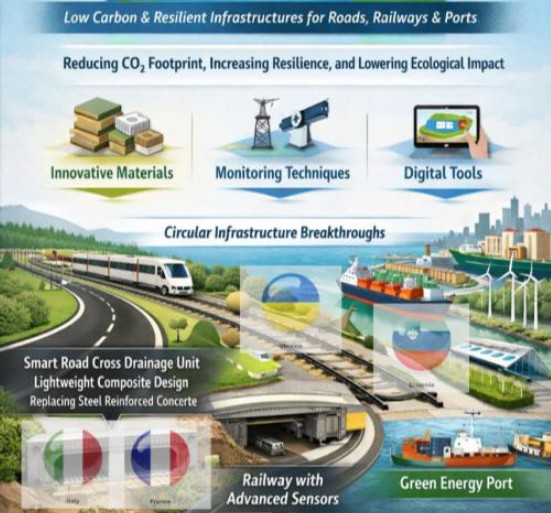
SHIFTIN: Towards Resilient, Sustainable, and Biodiversity-Friendly Transport Infrastructure
SHIFTIN aims to accelerate the transition to climate neutral, resilient and biodiversity friendly transport infrastructure by 2050. Roads, railways and ports rely on large volumes of raw materials, generate significant CO2 and air pollutant emissions, fragment habitats, and are increasingly exposed to floods, landslides and heatwaves. Despite many high maturity solutions in Europe, uptake remains slow because the sector needs clear standards, comparable performance evidence and procurement specifications.
SHIFTIN will demonstrate and combine circular low carbon construction materials, nature based measures, advanced monitoring and digital decision support to enable safer, more sustainable life cycle choices. Building on the LIAISON Dynamic Multi Infrastructure Governance Framework, the project will deliver defensible procurement evidence and practical tools for public buyers. It will deploy full scale pilots on four TEN T corridors (Atlantic, Scandinavian Mediterranean, Baltic Adriatic and North Sea Baltic), covering road, rail and port contexts.
Demonstrations will integrate innovative materials and services with network and asset monitoring (including satellite and on board sensing, IoT enabled structural health monitoring, and AI supported analytics). A Digital Twin based Integrated Decision Support Platform will convert performance data into transparent whole life indicators for carbon, circularity, resilience, biodiversity and costs, supporting robust business cases and maintenance planning.
SHIFTIN will translate results into outputs aligned with the Work Programme priorities on green and resilient TEN T infrastructure: guidance for standards and regulations, and ready to use procurement templates and model clauses that embed whole life sustainability, resilience and biodiversity requirements. This will reduce adoption risk, support green public procurement pilots and enable replication and market uptake across European transport networks.
MEMBERS
1 FUNDACION TECNALIA RESEARCH & INNOVATION Coordinator
2 IDP INGENIERIA Y ARQUITECTURA IBERIA SL
3 ECOLE NATIONALE DES PONTS ET CHAUSSEES
4 EIDGENOESSISCHE TECHNISCHE HOCHSCHULE ZUERICH
5 UNIVERSIDAD DE VIGO
6 RESEARCH DRIVEN SOLUTIONS LIMITED
7 Inframind Labs Ltd
8 UNIVERSITY COLLEGE LONDON
9 UNIVERSIDAD DE CANTABRIA
10 GRID ENGINEERS IKE
11 MINUARTIA ESTUDIS AMBIENTALS SL
12 ZAVOD ZA GRADBENISTVO SLOVENIJE
13 ACCIONA CONSTRUCCION SA
14 BOUYGUES TRAVAUX PUBLICS SA
15 POLITECNICO DI MILANO
16 CENTRO DE ESTUDIOS DE MATERIALES Y CONTROL DE OB
17 NEO ECO UKRAINE LLC
18 CENTRO DE ESTUDIOS Y EXPERIMENTACION DE OBRAS PUES
19 IZPITEK SOLAR SOCIEDAD LIMITADA
20 2TDK DRUZBA ZA RAZVOJ PROJEKTA DOO
21 DRUZBA ZA AVTOCESTE V REPUBLIKI SLOVENIJI D.D
22 AUTOSTRADE PER L'ITALIA SPA
23 FORUM DES LABORATOIRES NATIONAUX EUROPEENS DE
24 Maple Consulting Ltd
The participation of Applied Geotechnologies Research Group has been partially supported by Universidade de Vigo (Axudas propias á investigación da Universidade de Vigo, convocatoria 2025).